Soshi: Difference between revisions
SpiderEngine (talk | contribs) (Editing a gallery) Tag: gallery |
TheJoeMaster (talk | contribs) m (→Gallery) |
||
| (64 intermediate revisions by 10 users not shown) | |||
| Line 1: | Line 1: | ||
[[ | {{Person Infobox | ||
''' | |name=Soshi Tanaka | ||
|image=Photo Soshi.jpg | |||
|fullname=Soshi Tanaka | |||
|jpname=田中総史 | |||
|romaji=Tanaka Sōshi | |||
|alias=Soshi Kurei<br>Soshi-kun<br>Soshi<br>{{tt|久礼聡史|Kurei Sōshi}}<br>{{tt|ソーシくん|Sōshi-kun}}<br>{{tt|総史|Sōshi}} | |||
|born=July 7, 1986 | |||
|role=Vocalist | |||
}} | |||
{{Nihongo|[[generasia:Soshi|Soshi Tanaka]]|田中総史|Tanaka Sōshi}}, credited as {{Nihongo|Sohshi}} in ''[[Beat the Beat: Rhythm Paradise]]'', is a real-life Japanese vocalist who also appears in the ''[[Rhythm Heaven (series)|Rhythm Heaven]]'' series. | |||
==Biography== | |||
As a real-life vocalist, he performed the song [[WISH Kimi o Matenakute]] used in [[Remix 5 (GBA)|Remix 5]] of ''[[Rhythm Tengoku]]'', and the Japanese version of the song [[Lonely Storm]] used in [[Karate Man (Wii)|Karate Man]] and [[Karate Man 2 (Wii)|Karate Man 2]] in ''[[Rhythm Heaven Fever]]'' and [[Karate Man Combos!]] in ''[[Rhythm Heaven Megamix]]''. In the English cover of Lonely Storm, the vocals are covered by Clinton Edward Strother. | |||
As a character, he makes an appearance in [[Remix 5 (GBA)|Remix 5]] of ''[[Rhythm Tengoku]]'', where he performs the song, and is referred to as {{Nihongo|Soshi-kun|ソーシくん|Sōshi-kun}}<ref name="chara">[https://www.nintendo.co.jp/n08/brij/chara/stage05.html キャラクターアルバム ステージ5] (Character Album Stage 5)</ref>. He is depicted in ''[[Minna no Rhythm Tengoku Zen Vocal-shu]]'' due to performing the Japanese version of [[Lonely Storm]]. | |||
==Game Credits== | |||
*''[[Rhythm Tengoku]]'' - Song | |||
*''[[Rhythm Heaven Fever|Minna no Rhythm Tengoku]]'' - Singer | |||
**Credited in ''Minna no Rhythm Tengoku'' and ''Beat the Beat: Rhythm Paradise'' only | |||
==In-Game Appearances== | |||
===''[[Rhythm Tengoku]]''=== | |||
*{{EIL|GBA|5|6|class=pixelated}} (cameo in [[Toss Boys]] section, voice) | |||
===''[[Rhythm Heaven Fever]]''=== | |||
*{{EIL|Wii|7|4}} (voice) | |||
*{{EIL|Wii|10|4}} (voice) | |||
*{{EIL|Wii|10|5}} (voice) | |||
===''[[Rhythm Heaven Megamix]]''=== | |||
*{{EIL|3DS|S6|3}} (voice) | |||
==Gallery== | ==Gallery== | ||
;Artwork | |||
<gallery> | |||
Artwork GBA Soshi.png|Artwork from ''[[Rhythm Tengoku]]'' | |||
Artwork GBA Soshi Alt.png|Pre-release artwork from ''[[Rhythm Tengoku]]'' | |||
Artwork DS Rockers B.png|[[Rockers (characters)|J.J. Rocker's student]] from ''[[Rhythm Heaven]]'', who bears a resemblance to Soshi | |||
Artwork Wii Vocal Lonely Storm.png|Artwork from ''[[Minna no Rhythm Tengoku Zen Vocal-shu]]'' | |||
Artwork Wii Vocal Lonely Storm Alt.png|Artwork from ''[[Minna no Rhythm Tengoku Zen Vocal-shu]]'' | |||
</gallery> | |||
;Miscellaneous | |||
<gallery> | <gallery> | ||
Screenshot GBA Staff 5.png|As seen in [[Staff]] from ''[[Rhythm Tengoku]]'' | |||
</gallery> | </gallery> | ||
==Trivia== | |||
[[ | *Soshi is the first character in the ''[[Rhythm Heaven (series)|Rhythm Heaven]]'' series to bear the likeness of a real-life vocalist. Although there are a few other characters who are also caricatures of the real-life singers they are voiced by, such as [[Pop Singer]] and [[The Dazzles (characters)|the Dazzles]], Soshi is presented more as an insert than a proper character. | ||
[[ | **After Soshi's appearance in ''[[Rhythm Tengoku]]'', he was approached by guitarist [[generasia:Leo_(NaiL)|Leo]] to form the group [[generasia:Watashime Slug|Watashime Slug]], with Soshi being the vocalist. His in-game credits in [[Remix 5 (GBA)|Remix 5]] were updated to include the band's name in the [[Rhythm Tengoku (Arcade)|arcade version of ''Rhythm Tengoku'']]. | ||
[[ | **The [[Rockers (characters)|Rockers]]' design bear a striking resemblance to [https://www.last.fm/music/%E3%83%AF%E3%82%BF%E3%82%B7%E3%83%A1%E3%82%B9%E3%83%A9%E3%83%83%E3%82%B0 Watashime Slug], with the student specifically resembling Soshi. | ||
==External Links== | |||
*[[generasia:Soshi|Soshi]] - Generasia | |||
*[https://x.com/ald_soshi 総史 [@ald_soshi<nowiki>]</nowiki>] - Soshi on X | |||
==References== | |||
<references/> | |||
Latest revision as of 19:45, 27 August 2025
Soshi Tanaka (田中総史?, Tanaka Sōshi), credited as Sohshi in Beat the Beat: Rhythm Paradise, is a real-life Japanese vocalist who also appears in the Rhythm Heaven series.

Soshi-kun
Soshi
久礼聡史
ソーシくん
総史
related roles
Biography
As a real-life vocalist, he performed the song WISH Kimi o Matenakute used in Remix 5 of Rhythm Tengoku, and the Japanese version of the song Lonely Storm used in Karate Man and Karate Man 2 in Rhythm Heaven Fever and Karate Man Combos! in Rhythm Heaven Megamix. In the English cover of Lonely Storm, the vocals are covered by Clinton Edward Strother.
As a character, he makes an appearance in Remix 5 of Rhythm Tengoku, where he performs the song, and is referred to as Soshi-kun (ソーシくん?, Sōshi-kun)[1]. He is depicted in Minna no Rhythm Tengoku Zen Vocal-shu due to performing the Japanese version of Lonely Storm.
Game Credits
- Rhythm Tengoku - Song
- Minna no Rhythm Tengoku - Singer
- Credited in Minna no Rhythm Tengoku and Beat the Beat: Rhythm Paradise only
In-Game Appearances
Rhythm Tengoku

Rhythm Heaven Fever
 Karate Man (voice)
 Karate Man 2 (voice)
 Remix 10 (voice)
Rhythm Heaven Megamix
 Karate Man Combos! (voice)
Gallery
- Artwork
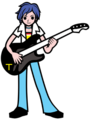
Artwork from Rhythm Tengoku

Pre-release artwork from Rhythm Tengoku

J.J. Rocker's student from Rhythm Heaven, who bears a resemblance to Soshi

Artwork from Minna no Rhythm Tengoku Zen Vocal-shu

Artwork from Minna no Rhythm Tengoku Zen Vocal-shu


- Miscellaneous

As seen in Staff from Rhythm Tengoku

Trivia
- Soshi is the first character in the Rhythm Heaven series to bear the likeness of a real-life vocalist. Although there are a few other characters who are also caricatures of the real-life singers they are voiced by, such as Pop Singer and the Dazzles, Soshi is presented more as an insert than a proper character.
- After Soshi's appearance in Rhythm Tengoku, he was approached by guitarist Leo to form the group Watashime Slug, with Soshi being the vocalist. His in-game credits in Remix 5 were updated to include the band's name in the arcade version of Rhythm Tengoku.
- The Rockers' design bear a striking resemblance to Watashime Slug, with the student specifically resembling Soshi.
External Links
- Soshi - Generasia
- 総史 [@ald_soshi] - Soshi on X
References
- ↑ キャラクターアルバム ステージ5 (Character Album Stage 5)